  1. Blog
  2. Article

Amrisha Prashar
on 4 February 2016

#UbuntuAtMWC Competition
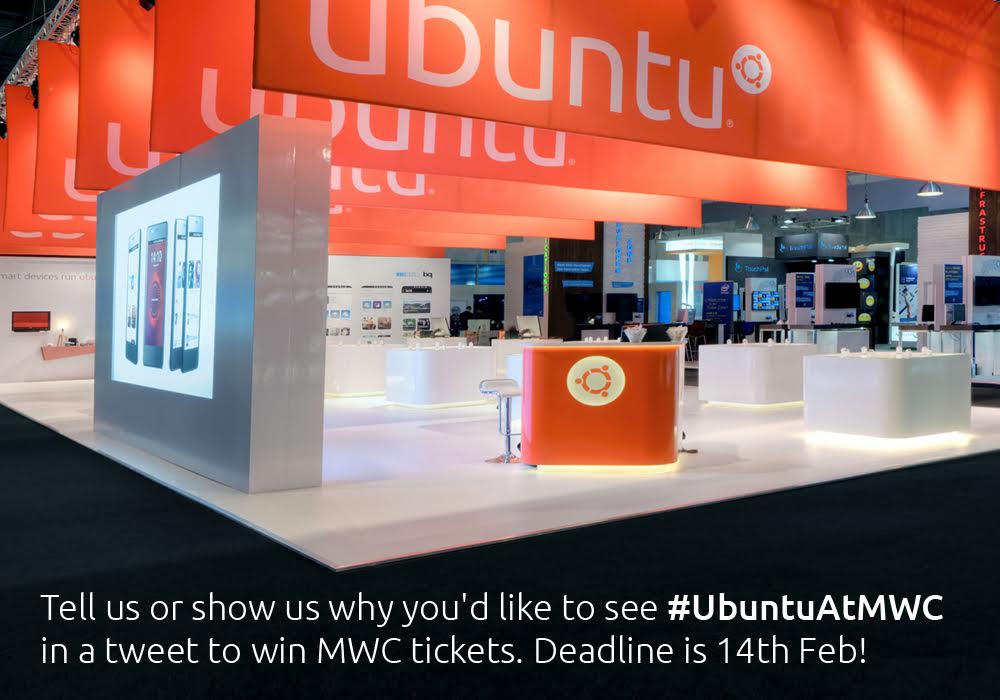

We’re really excited about MWC this year and can’t wait to showcase the various demos across Cloud and Devices!

For those of you not going we’d love to offer you the chance to come and join us and see what we have on display – as our presence is even bigger and better than last year.

To win tickets to MWC we’d like you to tell us or show us why you want to see Ubuntu at MWC in a tweet! Feel free to be as creative as possible with text, images, GIFs or even videos and add the hashtag #UbuntuAtMWC so we can track your awesome entries. The competition starts on 4th Feb (17:00 GMT) and finishes just before the stroke of midnight on Valentines day – 14th Feb (23:55 GMT.) Our creative team will judge the entries based on originality and select three winners where we’ll contact you via Twitter.

Happy creating and we can’t wait for your entries!

Terms and Conditions #UbuntuAtMWC

Related posts


Pedro Lazzarotto
11 June 2026

AI at the edge: simplifying infrastructure with Cisco and Canonical

AI Article

Legacy infrastructure was not designed for the requirements of the AI era. While large-scale model training remains centralized in data centers, test-time inference is rapidly shifting to the edge to reduce latency and bandwidth consumption. This shift creates a new frontier for enterprise AI, but deploying at the edge introduces signific ...


estelacarmona
11 June 2026

The next era of telco clouds: get open infrastructure choice with Sylva and Canonical Kubernetes

5G Article

Achieving vendor neutrality in telco clouds requires an infrastructure layer that respects open standards, without wrapping them in rigid platform layers. By combining upstream alignment with up to 15 years of support longevity, Canonical’s approach to Sylva is built around a requirement that matters deeply to telcos: follow upstream clou ...


Benjamin Ryzman
9 June 2026

What is RDMA over Converged Ethernet (RoCE)?

AI Networking

Previous articles walked through RDMA (Remote Direct Memory Access) as a programming model and InfiniBand as the fabric that was built around it. Both led to the same conclusion, even if it was never stated outright: moving data, not compute, becomes the bottleneck once systems scale. So what happens when you want RDMA, but you’re ...