

Bertrand Boisseau
2 March 2026
Cloud-native Android™ infotainment: your CI pipeline shouldn’t depend on hardware
More and more often, infotainment systems are being developed and delivered like software, yet often they are still tested and validated using hardware-centric processes. This is far from ideal: access to devices is limited, environments are difficult to reproduce, and iteration slows down as soon as multiple teams need to work in parallel. These challenges become even more visible as cockpit systems move toward wide displays and high resolutions.
At MWC, we are presenting a demo that showcases a different approach: infotainment development via cloud-native Android. By running Android as cloud workloads, they can be integrated directly into CI/CD pipelines, and streamed remotely at full 8K. The goal of this approach is not to replace hardware entirely, but to remove it as a bottleneck in day-to-day development, testing, and validation.
Android as cloud infrastructure
Anbox Cloud is a cloud-native platform for running Android and Android applications inside containers and streaming them with low latency to any device. Rather than tying Android to a specific board or bench, Anbox Cloud allows it to be deployed and managed like any other cloud service, which means the environments can be provisioned on demand, but also updated in a consistent manner and integrated directly into CI/CD pipelines.
In our demo, we run Android on a public cloud instance, but the same approach can be applied to on-premises deployments. The Android instance is automatically set up and accessed remotely. Anbox Cloud’s Android images include regular Android security patches, and Anbox Cloud is supported by Ubuntu Pro, which provides regular maintenance and security updates.
By running Android as an isolated, cloud-managed workload, users gain the security benefits of cloud infrastructures, such as stronger isolation and improved data protection when compared to shared hardware installations. Developers can choose to work with either Android Open Source Project (AOSP) or Android Automotive OS (AAOS), which includes Vehicle Hardware Abstraction Layer (VHAL) support.
What matters is that these Android instances are reproducible and scalable, which makes them suitable for automated workflows. Teams can rely on consistent environments, reducing time spent debugging environment-specific issues, therefore avoiding operational overhead, which is especially costly when scaling for development, testing, and reviewing.
From pull request to a running a cloud-native Android infotainment system
As you can see in our video, the demo itself starts on GitHub, where a pull request triggers a CI/CD workflow. This reflects how Anbox Cloud enables users to integrate Android-based infotainment development work into existing development pipelines, without introducing special-purpose tooling.
Watch the video:
Accelerating Automotive Infotainment with Anbox Cloud
In this setup, the underlying Anbox Cloud environment is already deployed and available. Instead of rebuilding an entire infrastructure from the ground up, our demo automation uses Anbox Cloud to provision Android workloads on demand, connecting the Android image to the development and testing environments.
Anbox Cloud then creates and starts an Android instance automatically. When the instance starts, the workflow connects to it and runs end-to-end tests with standard Android tooling. Test execution and validation happen as part of the CI process, and results are collected and published back to GitHub as artifacts.
At this point, the pull request now includes a link to the newly built Android system that was created and tested by the pipeline. This changes how reviews are done: instead of relying on screenshots, logs or recorded videos, all stakeholders can access the exact environment that was validated.
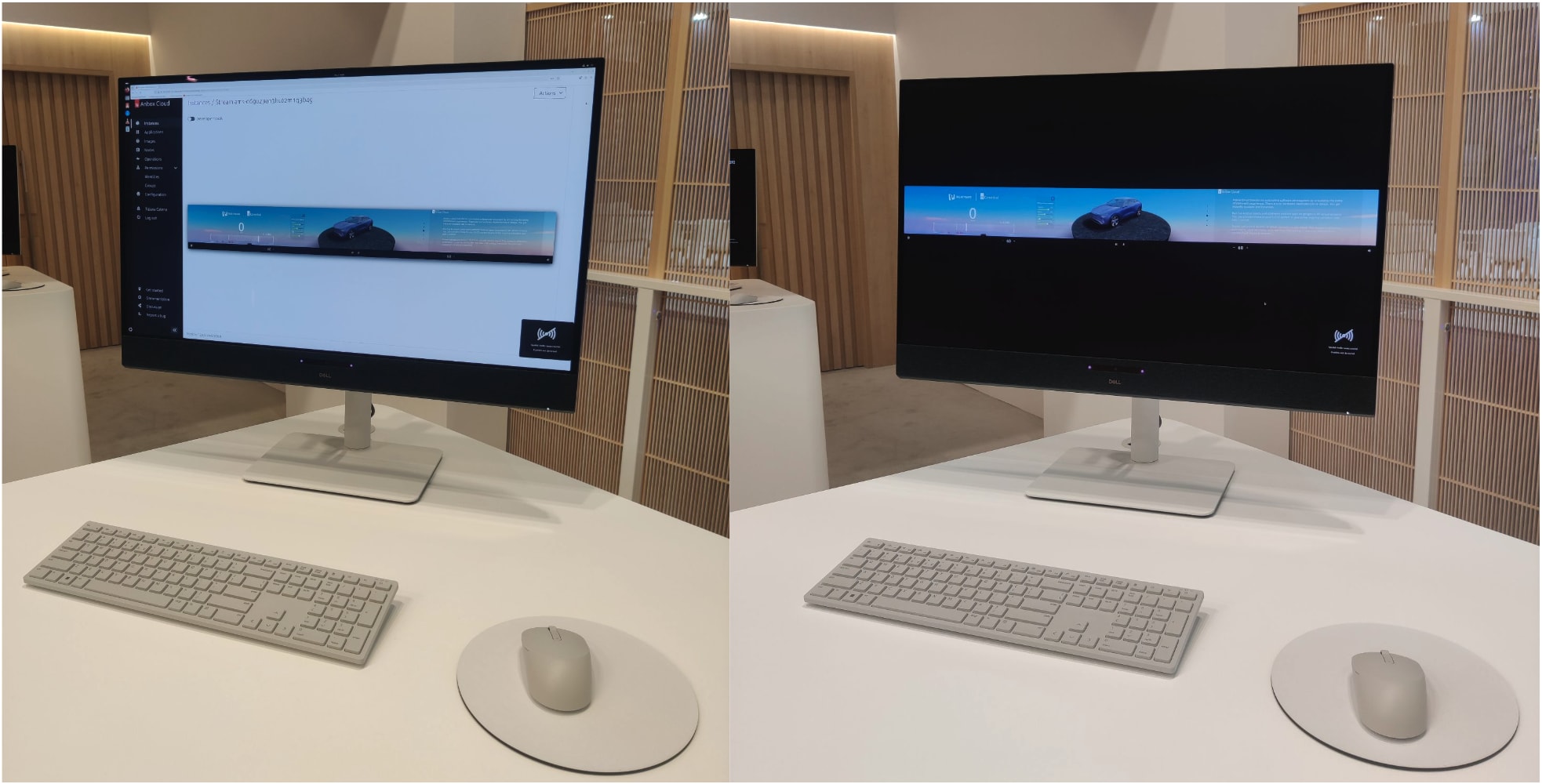
Demo pod at the Canonical MWC booth showing an Anbox Cloud instance streaming in 8K
a Kanzi-built infotainment HMI
Being able to interact directly with the running system means that reviewers can navigate in the UI, observe performance and responsiveness, and verify and play with the behavior under real conditions rather than assessing based on a static or partial representation. Reviews are more reliable and reduce misinterpretation due to missing context.

8K virtual Android device running on Anbox Cloud
Development teams can access the same system directly and stream it at full 8K resolution. The Android system image we used for this demo relies on a Kanzi-made UI from Rightware. The rendering quality and responsiveness are consistent with what teams expect from high-end infotainment setups, even if the system is running remotely.
“Kanzi has always been about empowering designers and developers to bring exceptional in-vehicle experiences to life,” says Tero Koivu, Co-CEO at Rightware. “Seeing a Kanzi made UI streamed at 8K through Anbox Cloud shows how cloud-native workflows can dramatically accelerate iteration and collaboration. It opens a powerful new path for teams building the next generation of connected, visually stunning automotive user interfaces.”
Reviewing what was tested
Once the tests are done, the Android instance is cleaned up to guarantee that each test remains isolated, yet repeatable, while avoiding costly and unnecessary persistent environments.
After the changes have been approved, merging the pull request triggers the next stage of the build or deployment pipeline, like any standard software delivery practice.
Hardware should be a reference, not a constraint
This demo shows that cloud-based scalable Android instances can be used to reduce the dependency on costly hardware for day-to-day development and validation tasks. Android can be run in the cloud and integrated directly into CI/CD workflows, allowing teams to scale instances, access them remotely, run tests in parallel, and collaborate more easily without sacrificing visual fidelity or system behavior.
At MWC, we are showing how Anbox Cloud facilitates this approach: Android infotainment systems treated as cloud infrastructure, built and tested automatically, and streamed at full resolution for review. It is a pragmatic way to bring modern software workflows to automotive HMI development.
Are you attending MWC? Come talk to us at our Canonical booth in hall 2, at stand 2D20, to discover all things Anbox Cloud.
Further reading
Anbox Cloud Documentation
Anbox Cloud Appliance
Learn more about Anbox Cloud or talk to our team
Read our latest whitepaper:
From emulator hell to cloud-native android streaming
Learn more about how Anbox Cloud helps with infotainment specific features:
https://ubuntu.com/blog/anbox-cloud-to-improve-infotainment
Android is a trademark of Google LLC. Anbox Cloud uses assets available through the Android Open Source Project.


