
How to deploy on GCE

Google Compute Engine is a popular subsidiary of Google that provides on-demand cloud computing platforms on a metered pay-as-you-go basis.
Google Cloud web console: console.cloud.google.com
Prerequisites
A physical or virtual machine running Ubuntu 24.04+
Juju 3.6+ installed via snap
Install the Google Cloud CLI
Install the Google Cloud CLI:
user@host:~$ Check the official the official Google Cloud documentation for other installation options.
To check it is correctly installed, run
user@host:~$ Google Cloud SDK 474.0.0
...
Authenticate
Log in to Google Cloud:
user@host:~$ Create an service IAM account for Juju to operate GCE:
user@host:~$ Created service account [juju-gce-account].
Check your list of accounts:
user@host:~$ DISPLAY NAME EMAIL DISABLED
...
Juju GCE service account juju-gce-account@canonical-data-123456.iam.gserviceaccount.com False
...
Create a private key:
user@host:~$ created key [aaaaaaa....aaaaaaa] of type [json] as [sa-private-key.json] for [juju-gce-account@canonical-data-123456.iam.gserviceaccount.com]
Add a policy binding to the IAM policy of the project:
user@host:~$ Bootstrap Juju controller on GCE
Due to a known Juju issue, move the newly exported Google Cloud JSON file into a snap-accessible folder:
user@host:~$ user@host:~$ Add GCE credentials to Juju:
user@host:~$ ...
Enter credential name: juju-gce-account
...
Auth Types
jsonfile
oauth2
Select auth type [jsonfile]: jsonfile
Enter path to the .json file containing a service account key for your project
Path: /var/snap/juju/common/sa-private-key.json
Credential "juju-gce-account" added locally for cloud "google".
Bootstrap a Juju controller:
user@host:~$ Creating Juju controller "gce" on google/us-east1
Looking for packaged Juju agent version 3.5.4 for amd64
Located Juju agent version 3.5.4-ubuntu-amd64 at https://streams.canonical.com/juju/tools/agent/3.5.4/juju-3.5.4-linux-amd64.tgz
Launching controller instance(s) on google/us-east1...
- juju-33f662-0 (arch=amd64 mem=3.6G cores=4)
Installing Juju agent on bootstrap instance
Waiting for address
Attempting to connect to 35.231.246.157:22
Attempting to connect to 10.142.0.17:22
Connected to 35.231.246.157
Running machine configuration script...
Bootstrap agent now started
Contacting Juju controller at 35.231.246.157 to verify accessibility...
Bootstrap complete, controller "gce" is now available
Controller machines are in the "controller" model
Now you can run
juju add-model <model-name>
to create a new model to deploy workloads.
See also: Juju | Google Cloud bootstrap options
You can check the instance availability in the web interface
Web interface: https://console.cloud.google.com/compute/instances
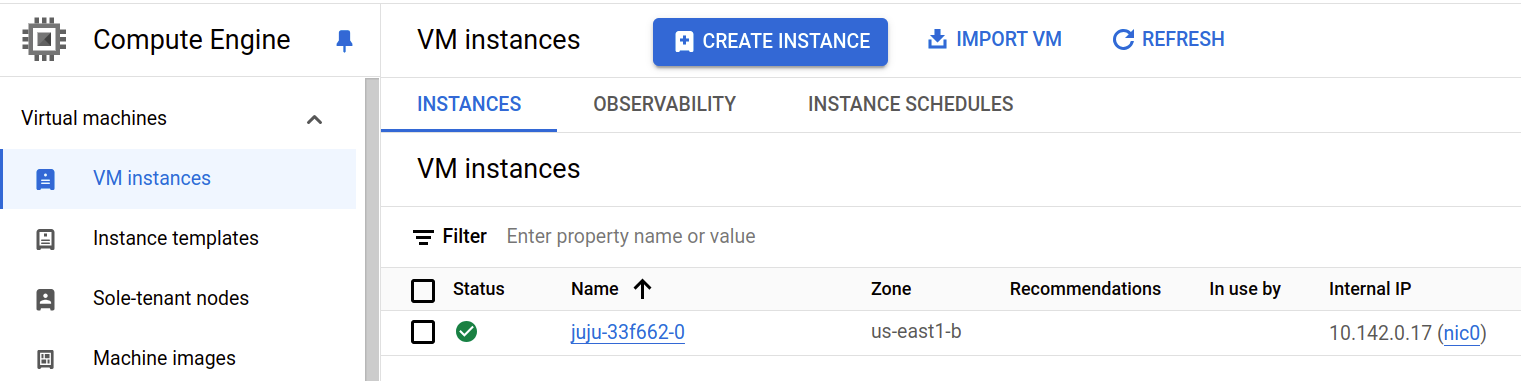
(Make sure to choose the right Google Cloud project!)
Access a test database (optional)
This section walks you through creating and accessing a test database in your newly configured cloud.
Create a Juju model:
user@host:~$ The following command deploys PostgreSQL and the data-integrator charm to request a test database:
user@host:~$ user@host:~$ user@host:~$ Once juju status shows the apps as active and idle, request the credentials for your newly bootstrapped PostgreSQL database:
user@host:~$ Take note of the values for <username>, <password>, and <endpoint>.
At this point, you can access your cloud database using the internal IP address.
All further Juju applications will use the database through the internal network:
user@host:~$ psql (15.6 (Ubuntu 15.6-0ubuntu0.23.10.1), server 16.9 (Ubuntu 14.12-0ubuntu0.24.04.1))
Type "help" for help.
test-db=>
Expose database (optional)
To access the database from outside of the cloud, open the the cloud’s firewall using juju expose:
user@host:~$ Be wary of opening ports to the public
Make sure you understand the risks before doing this in production.
Once exposed, you can connect your database using the same credentials as above except the IP. This time, use the public IP assigned by the cloud provider to the PostgreSQL instance.
You can find it it with juju status:
user@host:~$ ...
Unit Workload Agent Machine Public address Ports Message
postgresql/0* active idle 0 <public-ip> 5432/tcp Primary
...
user@host:~$ psql (15.6 (Ubuntu 15.6-0ubuntu0.23.10.1), server 16.9 (Ubuntu 14.12-0ubuntu0.24.04.1))
Type "help" for help.
test-db=>
To close public access, run:
user@host:~$ Clean up
Always clean cloud resources that are no longer necessary; they could be costly!
See all controllers in your machine with
user@host:~$ Controller Model User Access Cloud/Region Models Nodes HA Version
<controller-name> <model-name> admin superuser <cloud-name>/<region-name> 1 1 none 3.6.1
The following command will destroy the Juju controller and remove the cloud instance - meaning all your data will be permanently removed:
user@host:~$ Next, check and manually delete all unnecessary Google Cloud resources.
Run the following command to show the list of all your GCE instances:
user@host:~$ NAME ZONE MACHINE_TYPE PREEMPTIBLE INTERNAL_IP EXTERNAL_IP STATUS
juju-33f662-0 us-east1-b n1-highcpu-4 10.142.0.17 35.231.246.157 RUNNING
juju-e2b96f-0 us-east1-b n2d-highcpu-2 10.142.0.18 35.237.64.81 STOPPING
juju-e2b96f-1 us-east1-d n2d-highcpu-2 10.142.0.19 34.73.238.173 STOPPING
List your Juju credentials:
user@host:~$ ...
Client Credentials:
Cloud Credentials
google juju-gce-account
...
Remove Google Cloud credentials from Juju:
user@host:~$ Finally, remove Google Cloud JSON file user credentials to prevent any credential leakage:
user@host:~$