
Stereo mode

Stereo mode is a two-node high-availability topology for Charmed PostgreSQL. It runs the database on two postgresql units and adds a separate, lightweight postgresql-watcher application that contributes a third vote to the cluster’s Raft quorum. The watcher runs no PostgreSQL of its own — its only job is to make the cluster’s vote count odd, so that high availability works with only two database copies.
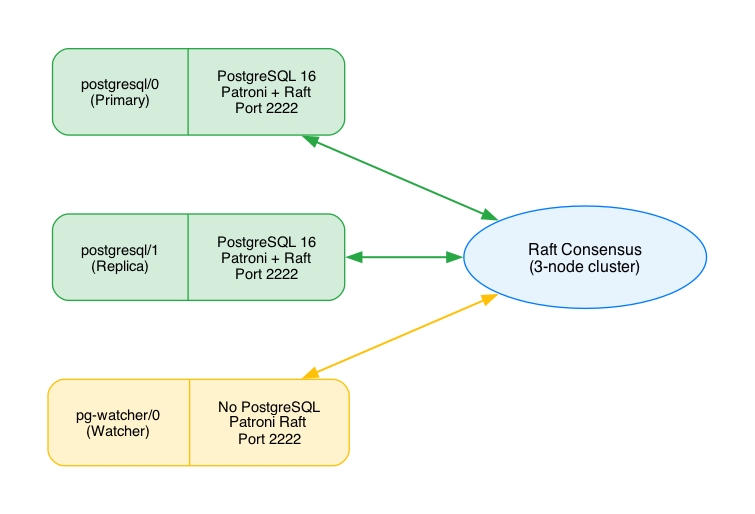
A stereo-mode deployment: two postgresql units plus a postgresql-watcher that contributes the third Raft vote on port 2222.
Why a third vote is needed
Charmed PostgreSQL uses Patroni for high availability, and Patroni elects a primary through Raft consensus. Raft requires a majority of voters to agree before it can elect a primary.
With an even number of voters, a single failure splits the cluster in half and neither half holds a majority:
2 voters, 1 lost → 1 remaining. One vote is not a majority of two, so the survivor cannot safely promote itself. Automatic failover stalls.
Adding a third voter restores a safe majority:
3 voters, 1 lost → 2 remaining. Two votes are a majority of three, so the cluster keeps operating and can fail over automatically.
Running a third full PostgreSQL unit is the most robust option, but it adds a third full copy of the data — 50% more storage and compute — for a workload that only needs two copies. Stereo mode is the middle ground: two real database units plus one tiny watcher.
How the watcher participates
The postgresql-watcher charm is deployed as a separate Juju application and integrated with postgresql over the watcher-offer endpoint (provided by postgresql) and the watcher endpoint (required by the watcher).
Once integrated, the watcher:
Runs only Patroni’s
patroni-raft-controllerfrom thecharmed-postgresqlsnap, started as a systemd service and listening on port 2222. It does not run PostgreSQL.Joins the cluster’s Raft quorum as a voting member, so two
postgresqlunits plus the watcher make three voters.
Note
The watcher participates in leader election only. It stores no table data and never becomes a PostgreSQL primary or replica.
For the watcher’s security posture — trust boundaries, hardening, inherent risks, and decommissioning — see Watcher security.
When the watcher votes (and when it doesn’t)
The watcher runs and votes only when the postgresql units would otherwise form an even voter count. When they already make a safe odd count on their own, the watcher stops its Raft service and leaves the quorum:
An even number of units (2, 4, 6, …): the watcher runs and votes, making the total odd — three voters for two units, five for four — so a single failure still leaves a clear majority.
An odd number of units, three or more (3, 5, 7, …): the watcher stops itself and leaves the quorum, because the
postgresqlunits already form an odd voter count — keeping it would make the count even again and degrade partition tolerance.A single unit: the watcher still runs and votes, but a one-unit cluster has no high availability either way — there is no second copy to fail over to.
This means you can keep the watcher integrated as you scale postgresql up and down: it stops itself only when the cluster is already an odd size of three or more, and runs otherwise.
Availability-zone placement
A watcher in the same availability zone (AZ) as a database unit provides little extra protection, so the watcher charm checks its placement once integrated and re-checks it as the deployment changes:
With
profile=production, the watcher blocks if it shares an AZ with a PostgreSQL unit.With
profile=testing, it only warns, which is convenient for local or single-AZ test setups.
See also
How to deploy in stereo mode (two-node HA) — deploy a stereo-mode cluster step by step.
Watcher security — the watcher’s security posture, hardening and decommissioning.
Architecture — the standard Charmed PostgreSQL architecture.
How to scale a cluster — scaling a standard cluster up and down.