Production blueprint (k8s)
This document outlines recommendations for operating OpenBao in a production environment.
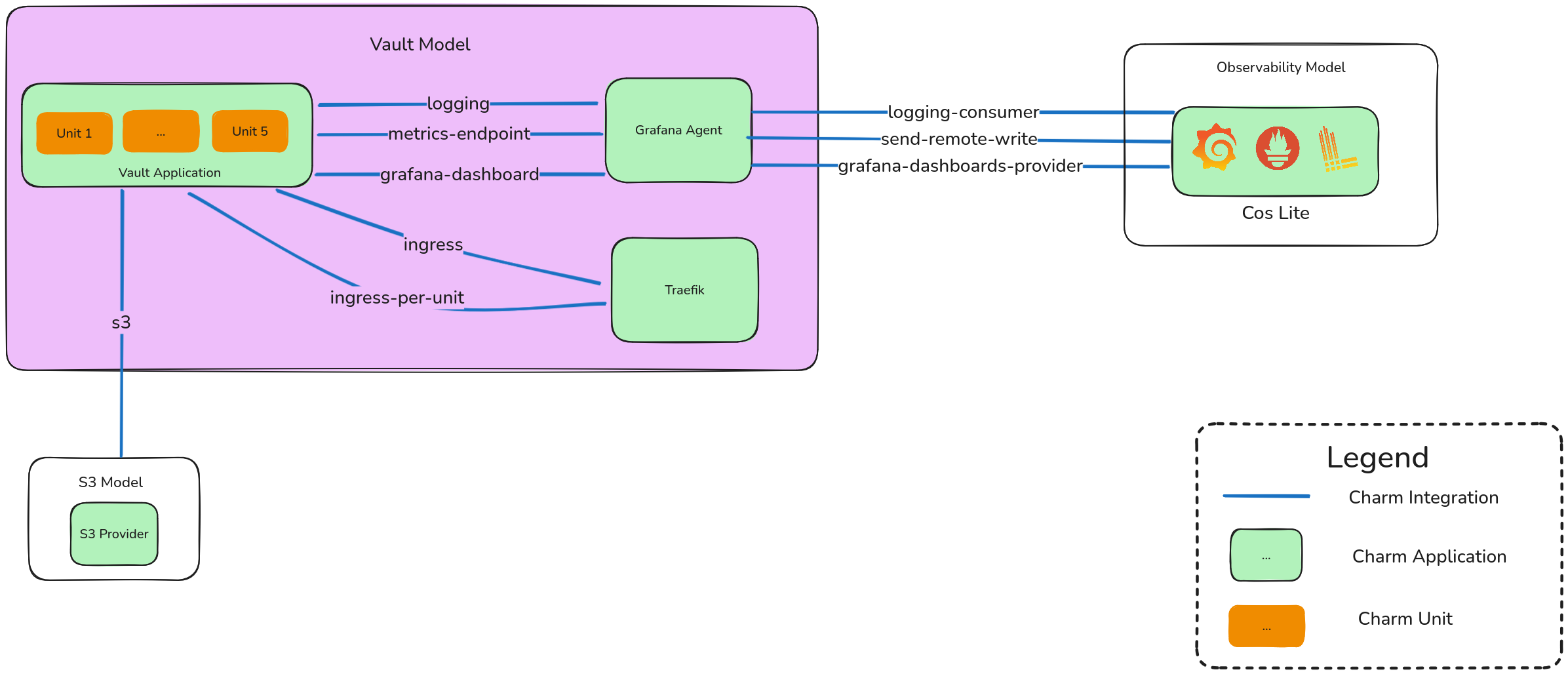
Infrastructure
Please follow the OpenBao project reference to deploy the OpenBao charms on hosts of appropriate size for your deployment.
High Availability
OpenBao should be deployed with a total of 5 units.
Observability
OpenBao should be integrated with Canonical Observability Stack:
OpenBao should be integrated with OpenTelemetry Collector using the
cos-agentcharm relation interface.OpenTelemetry Collector should be integrated with COS using the
logging,send-remote-write, andgrafana-dashboards-providercharm relation interfaces.
Storage
The OpenBao charm declares minimum storage sizes for its volumes. Juju will provision at least these amounts when deploying.
Important
Storage declarations cannot be changed after deployment on Kubernetes.
The charm defines the following storage volumes:
Storage name |
Purpose |
Minimum size |
|---|---|---|
|
Raft data directory |
10G |
|
OpenBao configuration files |
5M |
|
TLS certificates |
5M |
|
Temporary files |
5G |
You can provision larger volumes at deploy time using the --storage flag:
juju deploy openbao-k8s openbao --trust \
  --storage openbao-raft=50G \
  --storage tmp=10G
Note that some filesystems (e.g. XFS) enforce a minimum allocation unit larger than
the declared minimums. In such cases, use the --storage flag to specify sizes
compatible with your filesystem.
Backup and Restore
OpenBao should be integrated with an S3 provider to conduct regular backup operations.